
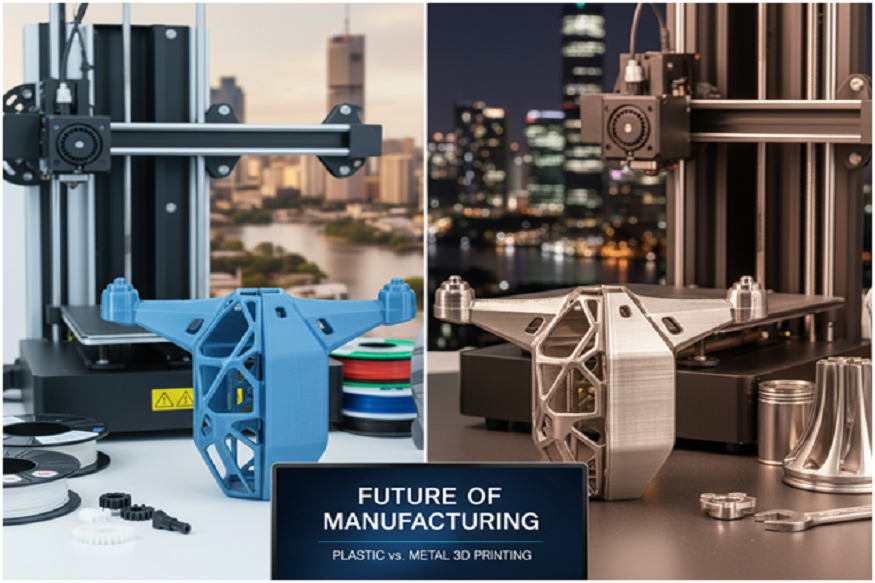
As Brisbane’s manufacturing and innovation sectors continue to evolve, businesses are increasingly turning to advanced 3D printing technologies to remain competitive. The choice between plastic and metal 3D printing is shaping the future of product development, prototyping, and manufacturing across industries in Brisbane. This article provides a comparative technical analysis of both technologies, outlining their functional differences, performance benefits, operational constraints, and adoption preferences among Brisbane businesses based on application requirements, cost structures, material characteristics, and prevailing industry trends.
3D Printing Brisbane: An Evolving Landscape
Brisbane has witnessed rapid adoption of 3D printing services, with companies leveraging this technology for prototyping, tooling, and end-use parts. The city’s diverse economy—spanning healthcare, automotive, aerospace, education, and manufacturing—demands versatile solutions. Local providers of 3D printing services in Brisbane have responded with a broad material offering, including both high-performance plastics and metals. This broad adoption is driven by the need for faster product development cycles, customisation, and the capability to fabricate complex geometries that are impractical or unattainable using conventional manufacturing processes.
Overview: Plastic vs Metal 3D Printing
| Feature | Plastic 3D Printing | Metal 3D Printing |
|---|---|---|
| Materials Used | ABS, PLA, PETG, Nylon, Polycarbonate, polymers | Stainless steel, titanium, aluminium, tool steels |
| Technologies | FDM, SLA, SLS | DMLS, SLM, EBM |
| Applications | Prototyping, concept models, educational tools | End-use parts, tooling, aerospace, medical implants |
| Advantages | Cost-effective, fast, versatile, complex geometries | High strength, heat resistance, durability |
| Limitations | Lower strength/heat resistance, limited durability | Higher cost, longer lead time, post-processing needed |
Plastic 3D Printing
- Materials Used: Plastics such as ABS, PLA, PETG, Nylon, Polycarbonate, and other engineering-grade polymers are commonly used. Each material offers unique characteristics—ABS is known for its toughness, PLA is biodegradable and easy to print, PETG combines strength and flexibility, while Nylon and Polycarbonate provide higher strength and durability for demanding applications.
- Technologies: The most popular plastic 3D printing technologies include Fused Deposition Modelling (FDM), Stereolithography (SLA), and Selective Laser Sintering (SLS). FDM is commonly adopted due to its low operating cost and straightforward implementation. SLA offers high-resolution prints suitable for detailed models, while SLS enables the production of complex parts without the need for support structures.
- Applications: Plastic 3D printing is ideal for rapid prototyping, allowing designers to quickly validate concepts and iterate designs. It is also used for functional prototypes, lightweight parts, medical devices, and educational models. The versatility of plastic materials makes them suitable for a wide range of industries.
- Advantages: Plastic 3D printing is cost-effective, especially for low-volume production and prototyping. It offers fast turnaround times, a wide range of colours and finishes, and the capability to fabricate complex geometries that are difficult to achieve using conventional manufacturing processes. The technology is readily adoptable by organisations across Brisbane, regardless of operational scale.
- Limitations: While plastics offer flexibility and design freedom, they generally have lower strength and heat resistance compared to metals. This limits their use in applications where mechanical performance is critical. Some plastics may also degrade over time when exposed to harsh environments.
Metal 3D Printing
- Materials Used: Metals such as stainless steel, titanium, aluminium, cobalt-chrome, and tool steels are commonly used in metal 3D printing. Stainless steel is selected for its high mechanical strength and inherent corrosion resistance, titanium for its lightweight and biocompatibility, aluminium for its excellent strength-to-weight ratio, and tool steels for their durability in tooling applications.
- Technologies: Metal 3D printing technologies include Direct Metal Laser Sintering (DMLS), Selective Laser Melting (SLM), and Electron Beam Melting (EBM). DMLS and SLM use lasers to fuse metal powders layer by layer, producing dense and strong parts. EBM uses an electron beam, which is particularly suitable for titanium and aerospace components.
- Applications: Metal 3D printing is used for manufacturing end-use components, custom tooling, aerospace and automotive parts, medical implants, and functional prototypes. The technology allows the fabrication of complex geometries and internal lattice structures that improve functional performance while minimising overall component mass.
- Advantages: Metal 3D printing delivers parts with high strength, heat resistance, and excellent mechanical properties. It is suitable for demanding environments where traditional plastics would fail. The technology supports the production of complex, lightweight, and custom metal parts, reducing material waste.
- Limitations: Metal 3D printing typically involves higher costs due to expensive materials and advanced equipment. The process can be slower than plastic printing, with additional time required for post-processing (such as heat treatment and surface finishing). Not all metals are readily available for 3D printing, and part size may be limited by machine capacity.
Key Factors Influencing Material Choice in Brisbane
1. Application Requirements
Plastic 3D printing is often chosen for projects where speed, cost, and design flexibility are priorities, such as early-stage prototypes or visual models. Businesses in Brisbane use plastic printing for quick iterations, allowing them to test and refine products efficiently. In contrast, metal 3D printing is selected for applications requiring mechanical strength, durability, and long-term performance. For example, aerospace manufacturers and medical device companies in Brisbane rely on metal printing for critical components that must withstand high stress or harsh environments.
2. Cost Considerations
Plastic 3D printing offers lower material and processing costs, making it ideal for startups and businesses with limited budgets or those needing rapid prototyping. The affordability of plastic printing encourages experimentation and design iteration. Metal 3D printing, while more expensive upfront, becomes cost-effective for complex, high-value parts or low-volume production runs where traditional tooling would be prohibitive. Brisbane businesses often weigh the initial investment against the long-term benefits of metal parts, especially for custom or high-performance applications.
3. Turnaround Time
Plastic 3D printing provides faster lead times, particularly for small batches or prototypes. This speed enables Brisbane companies to accelerate product development and respond quickly to market demands. Metal 3D printing, while generally slower due to the complexity of the process and post-processing requirements, still offers significant time savings compared to traditional machining for intricate parts. The ability to produce functional metal components in days rather than weeks is a major advantage for local manufacturers.
4. Material Properties
Plastic materials offer good flexibility, lightweight characteristics, and moderate strength, with chemical resistance varying by polymer type. These characteristics make plastics well suited for applications where low mass and simplified handling are critical. Metal materials, on the other hand, provide superior mechanical properties, including high strength, wear and corrosion resistance and the capacity to operate reliably under extreme temperature conditions. Brisbane businesses in sectors like mining, aerospace, and healthcare depend on these attributes for mission-critical parts.
5. Industry Trends in Brisbane
In Brisbane’s healthcare sector, metal 3D printing is increasingly used for patient-specific implants and surgical tools, thanks to its ability to produce biocompatible and durable components. Plastics remain popular for anatomical models and medical devices. The automotive and aerospace industries favour metal 3D printing for lightweight, high-strength components, while relying on plastic printing for prototyping and custom fixtures. Educational institutions and research organisations use plastic 3D printing for teaching, experimentation, and developing new products due to its affordability and versatility.
What Brisbane Businesses Prefer: Insights from Local 3D Printing Services
Plastic 3D Printing: The Go-To for Rapid Prototyping
Brisbane’s startups and product development firms often opt for plastic 3D printing to accelerate design iterations. The ability to quickly 3d print concept models and functional prototypes reduces time-to-market and development costs. Educational institutions also leverage plastic 3D printing for hands-on learning and research, allowing students to bring ideas to life and experiment with design concepts in a tangible way.
Metal 3D Printing: Driving Innovation in High-Performance Sectors
For industries where part performance is mission-critical, such as aerospace, medical, and advanced manufacturing, metal 3D printing is the preferred solution. Brisbane’s growing ecosystem of 3d metal printing services enables businesses to access complex geometries, lightweight designs, and custom metal parts that would be costly or impossible with traditional methods. This capability is especially valuable for producing low-volume, high-value parts where precision and reliability are essential.
Hybrid Approaches and Future Outlook
Many Brisbane businesses are adopting a hybrid approach—using plastic 3D printing for prototyping and metal 3D printing for final production. This workflow maximises both speed and performance, allowing companies to iterate quickly and then transition to robust, end-use parts. As metal additive manufacturing becomes increasingly accessible and cost-effective, its adoption is expected to rise, particularly among manufacturers seeking to localise supply chains, reduce lead times, and innovate with advanced materials.
Choosing the Right 3D Printing Service in Brisbane
When selecting a 3D printing partner, Brisbane businesses should consider: –
- Material Range: It’s important to choose a provider that offers both plastic and metal 3D printing to ensure flexibility for different project needs. A broad material selection allows businesses to match the right material to the specific requirements of each application.
- Technical Expertise: Providers with deep technical knowledge can advise on optimal material selection, design for additive manufacturing, and process optimisation. This guidance helps businesses achieve better results and avoid costly mistakes.
- Quality Assurance: Certifications such as ISO 9001:2015 demonstrate a provider’s commitment to quality management and consistent results. Quality assurance processes are crucial for industries with strict regulatory or performance standards.
- Turnaround Time: Rapid turnaround of prototypes or production components can have a substantial impact on overall project schedules. Providers that offer rapid turnaround help businesses stay agile and responsive to market changes.
- Support & Consultation: Ongoing support—from design consultation to post-processing and finishing—ensures a smooth experience from concept to production. Strong customer service is a key differentiator among 3D printing providers in Brisbane.
Conclusion
The choice between plastic and metal 3D printing Brisbane depends on application, budget, and performance requirements. In Brisbane, plastic 3D printing remains the dominant choice for rapid prototyping and education, while metal 3D printing is favoured for high-strength, functional parts in demanding industries. By utilising both technologies, Brisbane organisations can accelerate product development cycles, lower manufacturing costs, and shorten time-to-market. As the capabilities of 3D printing continue to expand, local companies are well-positioned to benefit from these transformative manufacturing solutions.












+ There are no comments
Add yours